 PP360

The complete walkthrough — every round, every feature
ProveIt, PragatiPath 360's free Mock Client Test
Everything you'll actually see and do, start to finish — real example conversations, the real scoring, your shareable Discovery Report, an evidence-based workshop match, live Round 3 judging status, and how referrals earn real credits.
This page walks through every stage in full detail — plus what you get after Round 1 regardless of score, and how referrals earn real credits.
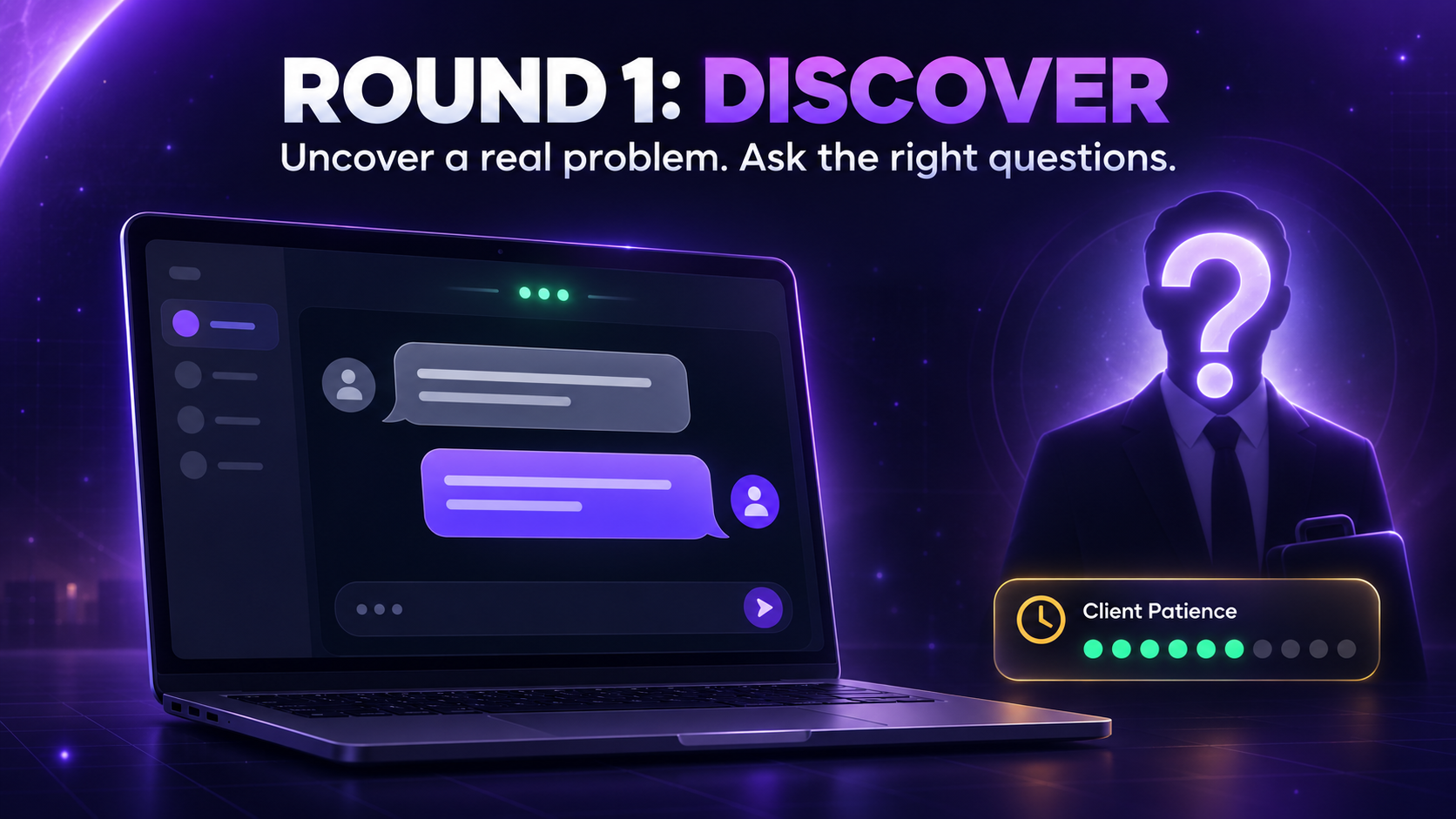
Discover — find the real problem
You're dropped into a live text chat with an AI playing a small-business owner with a genuine, unstated problem. Your only job: ask good enough questions to actually uncover it.
How it actually works, step by step
You're matched to a persona by your stated interest area
At registration you pick one of 25 interest areas (Retail, FinTech, Agriculture, EdTech, and so on). That exact choice determines which mock client you'll meet — not random, and not the same for everyone.
The client opens vague, on purpose
Real clients rarely say "I need X." They say something like "I need an app that manages everything" — your job is to ask the questions that get past that.
You ask questions — up to 10 of your own messages
Each persona is carrying a hidden constraint (a budget limit, a literacy issue, a trust problem, a compliance requirement) that only comes out if you ask the right question. It's never volunteered.
You propose a brief — what the problem actually is
Once you've got enough, you write out the real problem, the context, and the opportunity. The client either agrees it's accurate, or pushes back if you've missed something they told you.
You get a Discovery Score out of 100, instantly
Graded strictly — a vague, one-question attempt can score under 20. There is no floor. Your score (and a certificate either way) lands in your inbox the moment the brief is approved.
A real example — this is an actual persona, not a simplified one
What "good" actually looks like
The grading has no minimum floor — a student who asks one vague question and accepts whatever the client says can score under 20/100. What scores well:
Specific, targeted questions
"What exactly do you mean by manage everything?" beats "tell me about your business." Generic questions get generic answers.
Actually uncovering the hidden constraint
Through good questioning, not luck. If you never ask about it, it never comes out, and your score reflects that.
Efficiency
Reaching an accurate brief in fewer, sharper questions scores higher than a long conversation that got there by accident.
You get up to 10 of your own messages — the AI starts naturally steering toward a close only once you're genuinely near that limit, never halfway through.
A Round 1 brief being "approved" only means the conversation reached a workable scope. Your Discovery Score is the real filter: score 55 or above ("Good" or better) and Round 2 unlocks immediately. Below that, your attempt ends there.
Either way you keep your full Round 1 certificate, your actual score, and specific written feedback on what to sharpen — a below-bar attempt isn't wasted, it's final for that attempt, but it's not nothing.
You don't just get a number back
Every Round 1 conversation produces more than a Discovery Score — three real, specific things, grounded in your actual chat, not a generic template.
A shareable Discovery Report
A dedicated page you can download or share — your score, your persona, and what your own questions actually found, missed, and could have asked instead. Your real transcript is never shown or shared, only this summary.
A workshop match that explains itself
If your score doesn't clear 55, the SkillSprint workshop you're matched to isn't generic — it names the exact thing your own conversation missed, with a sharper question you could try next time.
Live Round 3 judging status
If you clear the bar and submit for Round 3, come back anytime to see exactly where your entry stands — against the real dates this cycle's judging is expected by, not silence until an email arrives.
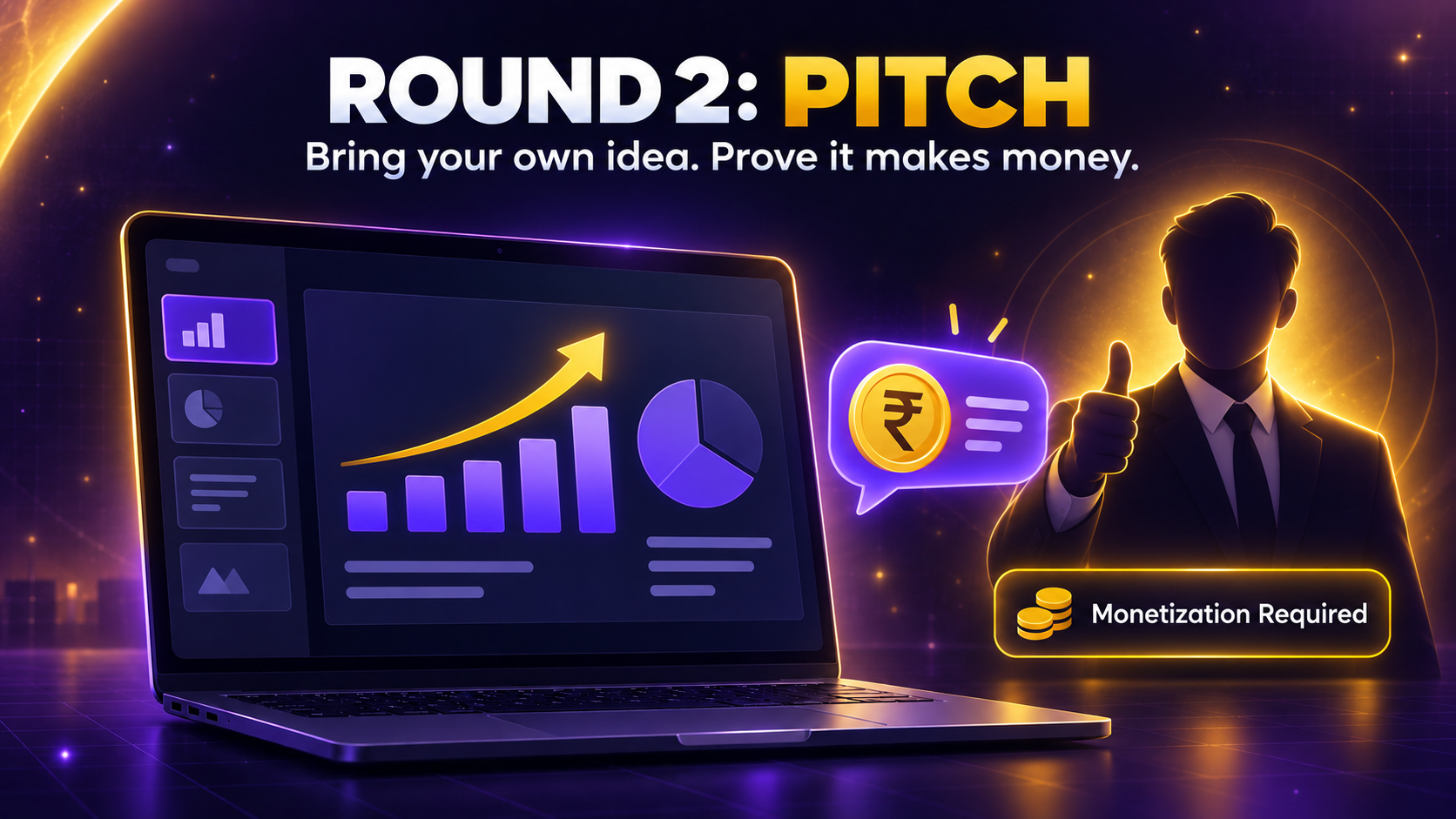
Pitch — defend your own startup idea
The same client is still on the line — but now you bring whatever idea you actually want to build. It doesn't have to solve the problem from Round 1 at all.
The pitch template — fill this in, exactly like a real investor one-pager
Round 2 opens with a structured template instead of a blank box — modelled on real Startup India / DPIIT self-certification criteria and the way an actual investor one-pager is structured. Each field maps to one of the five things that get scored.
After you send it
The client reacts for real
They'll push on whatever's weakest — a missing revenue model, an unrealistic build, a target user that doesn't match who actually pays. Up to 8 of your own replies to get to a genuine endorsement.
A clear, concrete idea gets approved
What it builds, roughly how, who it's for, why it's worth building, and how it makes money — once that's all genuinely there, Round 2 completes.
The idea is graded on its own merits — not the Round 1 problem
Five dimensions, 0-20 each, 0-100 total. This is a separate, strict score from your Discovery Score.
What actually gets scored in Round 2
The same five dimensions every pitch is judged on — in the spirit of a real Startup India / state MSME scheme review panel, not a friendly classroom exercise.
Problem-Market Fit 0-20
Is this a real, specific problem for a real, identifiable customer — not a vague "everyone needs this"?
Feasibility 0-20
Can this realistically be built by a first-time founder with limited capital and no team — not something that secretly needs millions in funding?
Scalability & Business Model 0-20
Who pays, how much, how often — and is there a real path from one customer to a repeatable business?
Government-Scheme Readiness 0-20
Would this survive a real DPIIT/Startup India recognition review — genuine substance, not generic "AI-powered platform for X" buzzwords?
Originality 0-20
Genuine insight versus an interchangeable copy of an existing well-known product with no real differentiation.
Most scores land in the 30-65 range on purpose — genuine standout ideas are rare, and a score above 80 is reserved for ideas with real, specific, defensible substance across all five dimensions. School-age participants are scored on a fair, age-appropriate version of the same five dimensions, not held to a working founder's bar.
Round 1 vs. Round 2 — side by side
| Round 1 — Discover | Round 2 — Pitch | |
|---|---|---|
| What you're judged on | Your questioning skill — can you uncover a hidden real problem? | Your idea itself — on its own merits, for whatever customer you choose |
| Whose problem | The mock client's real, hidden problem | Your own idea — doesn't need to relate to Round 1 at all |
| Input format | Free-text questions | A structured pitch template, then free-text replies |
| Message limit | Up to 10 of your own messages | Up to 8 of your own messages |
| Score range | Discovery Score, 0-100 | Idea Viability Score, 0-100 across 5 dimensions |
| To proceed | Score 55+ unlocks Round 2 | An approved pitch unlocks Round 3 (submission & judging) |
Who you might actually meet
25 distinct mock client personas, one per interest area. You're matched to the one tied to the interest area you register with.
Submit — put your idea in front of a human panel
Round 1 and 2 were both AI conversations. Round 3 is where a real person reads your concept and decides: shortlist, winner, or not this cycle.
What you submit
A pitch deck link or a written concept note
At least one of the two is required — a slide deck URL, or a one-page written note, whichever you actually have ready.
A monetization plan
Who pays, how much, how often — required, same discipline Round 2's pitch template already asked for.
A Business Model Canvas (optional)
If you have one, it strengthens the submission — not required to submit.
Then you can actually watch it move
This used to be "submit and wait for an email." Now every submission has a live status page, tracked against this cycle's own published shortlist and results dates.
What happens after judging
Shortlisted or Winner → a Certificate of Distinction/Achievement
Announced by email, visible immediately on your status page too.
Get matched to a workshop either way
Your weakest scoring dimension and your stated interest area are matched — server-side, with the reasoning shown back to you — against a real catalogue of 13 SkillSprint workshops.
Build it with a human — ₹499
A 4-hour, trainer-led workshop where you build one real, reviewed output. Most participants are matched first to Retail & Sales, the original flagship workshop.
Every referral earns real credits — not just a badge
Become an Innovation Captain: share your own persona-specific link, and every person you refer who completes Round 1 earns you a tangible reward, on top of a badge as your network grows.
Your link is persona-specific — e.g. "Meet Farha, who refuses to pay more than ₹500/month" — so whoever clicks it already knows exactly what they're walking into, not a generic sign-up link.
Questions you're probably asking
Does my Round 2 idea have to solve the Round 1 problem?
No. Round 1 proves you can research and understand a real user. Round 2 is whatever startup idea you actually want to build, for whatever customer you're targeting — completely independent of what you discovered in Round 1.
What if I don't clear 55 in Round 1?
Your attempt for this cycle is final — Round 1 can only be completed once, in a single sitting. But you still receive your full certificate of participation, your real score, and specific written feedback on exactly what to sharpen for next time.
Can I use ChatGPT or another AI to write my answers?
The system has a soft signal for pasted or implausibly fast messages — not proof of AI use, just a flag a reviewer can see. More importantly: a pasted, generic answer scores badly against this rubric regardless, because it rewards specific, targeted questions and genuine substance, not length.
Is this really free?
Yes — Round 1, Round 2, and Round 3 are all free, no card required at any point. The only paid step in the whole cycle is Stage 5, the optional 4-hour SkillSprint workshop (₹499/seat, ₹399/seat for groups of 5+).
How long does this actually take?
Round 1 is typically 10-15 minutes of real back-and-forth. Round 2, once unlocked, is similar. Budget 30-40 minutes total if you're doing both in one sitting.
What's the Business Model Canvas / monetization plan for, exactly?
Those come later, in Round 3 — the submission stage, where your approved Round 2 idea is formalised into a proper concept note and monetization plan ahead of human judging. Round 1 and Round 2 are both live conversations, not documents.
Can I actually share my Discovery Report, or is it just for me?
It's built to share — a dedicated page you can download as an image or send directly. Your real conversation transcript is never shown or shared; the report only ever contains the summary (score, what was found/missed, the sharper question) that's already visible to you.
Do I have to wait for an email to know my Round 3 result?
No — once you submit, a live status page shows exactly where your entry stands (Received, Shortlisted, or Decision made), tracked against the real shortlist and results dates for your cycle. You'll still get an email on a decision, but you don't have to wait for it to check.
Ready to meet your mock client?
Pick your interest area, get matched to a persona, and find out what you're actually capable of — free, start to finish.